Monday, June 17, 2013

How the Sweet Potato Stacks Against the Regular Potato


Why do I prefer the sweet potato over the common potato?  The sweet potato has:
~40% less starch
Tons of vitamin A
~2x more vitamin C
The SWEET POTATO:

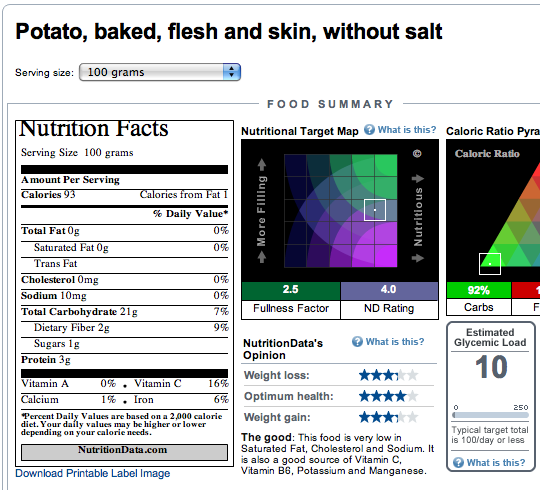
THE COMMON POTATO:


SOURCES:
SWEET POTATO NUTRIITION FACTS
POTATO NUTRITION FACTS

What is your optimal weight? Maybe it is the one that minimizes your waist-to-weight ratio


There is a significant amount of empirical evidence suggesting that, for a given individual and under normal circumstances, the optimal weight is the one that maximizes the ratio below, where: L = lean body mass, and T = total mass.

L / T

L is difficult and often costly to measure. T can be measured easily, as one’s total weight.

Through some simple algebraic manipulations, you can see below that the ratio above can be rewritten in terms of one’s body fat mass (F).

L / T = (T – F) / T = 1 – F / T

Therefore, in order to maximize L / T, one should maximize 1 – F / T. This essentially means that one should minimize the second term, or the ratio below, which is one’s body fat mass (F) divided by one’s weight (T).

F / T

So, you may say, all I have to do is to minimize my body fat percentage. The problem with this is that body fat percentage is very difficult to measure with precision, and, perhaps more importantly, body fat percentage is associated with lean body mass (and also weight) in a nonlinear way.

In English, it becomes increasingly difficult to retain lean body mass as one's body fat percentage goes down. Mathematically, body fat percentage (F / T) is a nonlinear function of T, where this function has the shape of a J curve.

This is what complicates matters, making the issue somewhat counterintuitive. Six-pack abs may look good, but many people would have to sacrifice too much lean body mass for their own good to get there. Genetics definitely plays a role here, as well as other factors such as age.

Keep in mind that this (i.e., F / T) is a ratio, not an absolute measure. Given this, and to facilitate measurement, we can replace F with a variable that is highly correlated with it, and that captures one or more important dimensions particularly well. This new variable would be a proxy for F. One the most widely used proxies in this type of context is waist circumference. We’ll refer to it as W.

W may well be a very good proxy, because it is a measure that is particularly sensitive to visceral body fat mass, an important dimension of body fat mass. W likely captures variations in visceral body fat mass at the levels where this type of body fat accumulation seems to cause health problems.

Therefore, the ratio that most of us would probably want to minimize is the following, where W is one’s waist circumference, and T is one’s weight.

W / T = waist / weight


Based on the experience of HCE () users, variations in this ratio are likely to be small and require 4-decimals or more to be captured. If you want to avoid having so many decimals, you can multiply the ratio by 1000. This will have no effect on the use of the ratio to find your optimal weight; it is analogous to multiplying a ratio by 100 to express it as a percentage.

Also based on the experience of HCE users, there are fluctuations that make the ratio look like it is changing direction when it is not actually doing that. Many of these fluctuations may be due to measurement error.

If you are obese, as you lose weight through dieting, the waist / weight ratio should go down, because you will be losing more body fat mass than lean body mass, in proportion to your total body mass.

It would arguably be wise to stop losing weight when the waist / weight ratio starts going up, because at that point you will be losing more lean body mass than body fat mass, in proportion to your total body mass.

One’s lowest waist / weight ratio at a given point in time should vary depending on a number of factors, including: diet, exercise, general lifestyle, and age. This lowest ratio will also be dependent on one’s height and genetic makeup.

Mathematically, this lowest ratio is the ratio at which d(W / T) / dT = 0 and d(d(W / T) / dT) / dT > 0. That is, the first derivative of W / T with respect to T equals zero, and the second derivative is greater than zero.

The lowest waist / weight ratio is unique to each individual, and can go up and down over time (e.g., resistance exercise will push it down). Here I am talking about one's lowest waist / weight ratio at a given point in time, not one's waist / weight ratio at a given point in time.

This optimal waist / weight ratio theory is one of the most compatible with evidence regarding the lowest mortality body mass index (, ). Nevertheless, it is another ratio that gets a lot of attention in the health-related literature. I am talking about the waist / hip ratio (). In this literature, waist circumference is often used alone, not as part of a ratio.

Tuesday, June 11, 2013

Fresh & Quick Summer Dinner

Summer is in full swing here.  Hot days, flip flops, pool time, and quick dinners cooked outside on the grill.  This meal is one of my favorite summertime suppers and is so easy to pull together.  Fresh corn is begging to come home with me from the grocery store and I can't get enough of it.  Tomato and avocado salad is a year-round favorite, and so colorful with this dish. And finally, a marinated skinless, boneless chicken breast is grilled to juicy perfection. 


Marinade (Finger Lickin' Chicken Marinade from Food.com)
-for 4-6 chicken breasts
  • 1 cup oil
  • 1/2 cup vinegar
  • 2 tablespoons Miracle Whip Light
  • 3 tablespoons Worcestershire
  • 2 tablespoons lemon juice
  • salt and pepper to taste
  • 2 tablespoons thyme
  • 1 tablespoon garlic salt

Mix all the ingredients together and marinate for at least 30 minutes and up to overnight in the refrigerator.  Grill the chicken for about 8 minutes on each side, depending on the size of the chicken.  


This marinade makes for delicious chicken friends, really moist and flavorful. 


Tomato & Avocado Salad
  • Tomato (4)
  • Avocado (3)
  • Red onion (1/3 cup) 
  • Light ranch salad dressing (couple tablespoons)
  • Tony Chachere salt-free seasoning (to taste)
Dice the tomato, avocado, and red onion and toss together with the dressing and seasoning.

Corn-on-the-Cob

  • Shuck the corn and boil for about 8 minutes.  


Happy summer friends!


Hair Diary || Ombre Color for the Summer

The resulting hair color.
My red highlights from about 2.5 years ago had grown out and faded gradually and so I've been back to my natural beautiful black color (with a few faded sections) for some time.  With summer approaching and my itch for a change intensifying, I decided to dye my ends brown for an ombre effect.  The brown did not come out as light as I thought it would but it is growing on me.  I may or may not decide to go lighter in a few months.  We will see.

Circa January 2011.  My red highlights months were done circa November 2010.
Clairol Textures & Tones is a popular brand among naturals, largely because it does not dry out and damage our strands as other dyes can.  I don't know whether I like the product yet.  We'll see how the color fairs over the next few months.  (I let the color set for 35 minutes before rinsing.) 
This is how I achieved the ombre.
I figured it would be easiest to work from  eight big braids and apply the color to the ends (which I left unbraided).
The result.  It looks more subtle in person.
The result.  The flash enhances the color.  It looks more subtle and less red in person.
It looks more subtle in person.

Pool Hair Care || Using Vitamin C to Neutralize Chlorine

The weather is warm.  You go for a swim in the pool.  Even after taking all the measures necessary to prevent the pool water from reaching your hair, perhaps your tresses still get drenched ... and encounter chlorine.  Fortunately, there are shampoos on the market that are specifically made to remove chlorine from your hair, but what if you want a cheaper or natural alternative?

Ascorbic acid is one option.  There are quite a few experiments (and studies) out there involving the use of this form of vitamin C to neutralize chlorine in the realm of water treatment.  Additionally, ascorbic acid can be purchased online or in certain health stores in capsule, crystalline, or other forms.

If you are interested in making your own mixture to remove chlorine from your hair, do read more about ascorbic acid as an option.

SOURCES:
VITAMIN C DECHLORINATION IN WATER SYSTEMS
VITAMIN C (ASCORBIC ACID)
ASCORBIC ACID REDUCTION OF RESIDUAL ACTIVE CHLORINE IN WATER (2000)

...a taste of mortality

STOP PRESS: 
I’m working out of the country for a couple of weeks and will be posting the odd spontaneous reflection on different places and spaces (see below). I hope it’s not too self-indulgent and of some interest to you!

Please make a note in your diaries and share the following information which, along with other exhibition-related events, is on a dedicated MORTALITY blog page.


Mortality: Death and the Imagination
8th July – 16th August 2013

Ian Breakwell | Felix Gonzalez-Torres | Douglas Gordon | Julian Opie 
Cornelia Parker |  Bob and Roberta Smith | Sam Taylor Wood

The Holden Gallery
Manchester Metropolitan University, Grosvenor Building, Cavendish Street, Manchester, M15 6BR

To mark the opening of Mortality, Dr Iona Heath will present a new paper, MEMENTO MORI.

“Today, we who live in the richer countries of the world have the unprecedented good fortune of a gratifyingly extended expectation of life but, apparently still dissatisfied with this, we seem to want to push it further and pretend that life can be indefinitely extended.”

For full details of this free public lecture on Friday 5th July and the private view go to: http://mortalitydeathandtheimagination.webs.com

                   +

From DEATH-TALKING to DELIRIUM
On Monday 8th of July we are pleased to welcome some truly creative minds from the field of health, medicine and the arts to share some of their passions and ideas from their practice and as a response to the exhibition.

Dr Sam Guglani is a consultant in clinical oncology and curates ‘Medicine Unboxed’ an NHS initiative engaging the public and front-line NHS staff with a view of medicine that is infused and elaborated by the humanities. Molly Carlile has a clinical background in specialist palliative care nursing, counselling and education and manages Palliative Care Services at Austin Health in Australia. Victoria Hume is an NHS arts manager, who has written a series of songs about hallucinations in intensive care, based on interviews with people who have been through this extraordinary experience, and with the staff who care for them.

For dates and times and more details about this free event, go to: http://mortalitydeathandtheimagination.webs.com

Please don’t write to Clive as he is not able to reply to email at the moment. Contact details for MORTALITY are on the dedicated pages.

Tuesday, June 4, 2013

Protective Style Lookbook || Elegant Cinnabun on Stretched Hair

By popular demand, this is a series showcasing various protective hair styles.  Protective styling does not have to be boring. :o)
Model: Onyxbeauty1988

Difficulty level: 2/5

Description: Cinnabun on blown out or stretched natural hair.