Thursday, December 13, 2012

Protective Style Lookbook || Vintage Updo on Stretched Hair

By popular demand, this is a series showcasing various protective hair styles.  Protective styling does not have to be boring. :o)


Model: MsVaughn

Style description: Updo incorporating side flat twists into a vintage roll.  Pinned side bang.

Difficulty level: 2/5


Healthy Eating || Bananas and Lowering Blood Pressure

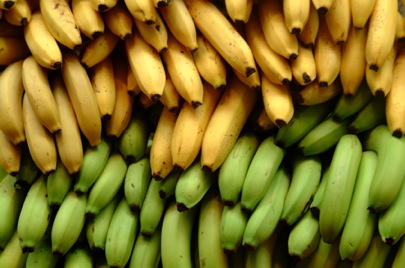
Lately my blood pressure has been lower than usual, which isn't a bad thing at all in this case.  The systolic pressure normally ranges between 101 and 110 while the diastolic pressure between 65 and 80.  However, my two most recent tests were 91/60 and 93/57. I don't recall my blood pressure ever being this low ... at least not in recent years.

So, I thought to myself, "What have I been doing differently?"  And then it occurred to me, "Well, I've been eating a lot of bananas [in smoothies].  Could that be it?"  Then I went to the internet, did some digging, and learned that there are dozens of references to the high potassium in bananas helping to lower blood pressure.  Here are a couple of abstracts worth reading:

ROLE OF POTASSIUM IN REGULATING BLOOD PRESSURE
EFFECT OF BANANA ON COLD-STRESS INDUCED HYPERTENSION

MORE READS:
BLOOD PRESSURE CHART AND TIPS

DISCLAIMER: Please speak with your doctor before changing your diet.

Tuesday, December 11, 2012

Homemade Low Fat Chocolate Mocha

This time of year, I love to sip on a hot cocoa.  It just turned cold here, so it's especially toasty to drink one at night.  I make mine with skim milk and Ghiradhelli double chocolate powder.  Their serving size is 4 tablespoons, but I think 2 is plenty.  To make it into a mocha, I add one scoop of espresso powder.  To be decadent, top with a swirl of fat free whip cream.  Even fat free whip cream is delicious.


Nutrition:  


* * * * * 
The winner of a $100 Nordstrom gift card will be announced on Friday.  Go HERE to enter!


2013 Plans for My Hair, Body, and Soul || Part I

(Left) Stretched puff in 2009. (Right) Braid-out on flat-ironed hair in mid-2012.

This year flew by sooo fast!  With a new year quickly approaching, it's that time (again) to map out some plans.  Here I go:

2013 HAIR PLANS:

Show more length.  I'm officially going the heat route because I want to enjoy my length more.  February will make it five years that I've been natural, and a huge majority of that time, my hair has looked shoulder-length (and sometimes, neck-length) because of major shrinkage.  I didn't have a problem with that, but I'm just ready to enjoy (and show) my length now.  From January through February, I will wear box braid extensions again.  Then from February through December, I plan to heat style monthly (or bi-monthly) and wear a mix of jumbo twists and braidout updos.  This will obviously impact the running of my usual 3in6 Challenge ... more on this later.

Maintenance over length.  Up until now, I've been focused on growing my hair to it's maximum length potential.  After grazing waist-length for some time, I believe that I'm approaching (or have reached) my terminal length.  Also, after almost five years of being natural, I've grown less obsessed with length.  That being said, I'm going into this heat routine knowing that length retention and heat usage may not mix well.  So, 2013 will be more about maintaining the length that I do have.  If I can also add to my length, that will be great, but it is not my priority.

Maintaining my kinks.  I want to make it clear that I am not going into this heat routine with the intention of changing my coil pattern.  I love my "kinks" and still want to wear them from time to time next year.  The challenge will be using heat without altering my pattern too much.  

To be continued ....

Do you have any hair plans or resolutions for the New Year?

Mixology || Baking Soda and Avocado Shampoo Recipe for Dry Hair

Looking for a simple, homemade natural shampoo that is cleansing but non-drying?  Check out this recipe:

Ingredients:
avocado
baking soda
distilled water

Directions:

  1. Skin an avocado, remove the pit and mash it in a bowl;
  2. Add 2 teaspoons of baking soda;
  3. Add 1/4 cup of hot distilled water; and
  4. Mix the ingredients into a paste and massage the homemade moisturizing shampoo into your hair and scalp.
  5. (Optional) You may or may not want to follow up with an apple cider vinegar rinse for pH balance.

Remember to refrigerate the unused mixture. To customize this or any of the other recipes, add a few drops of essential oil for a pleasant scent. Popular oils include lavender, sandalwood, jasmine and rosemary.

For more moisturizing shampoos, check out Suite101: Shampoo Recipes for Dry Hair and Scalp.

Monday, December 10, 2012

...

Some first Australian thoughts
Sorry for the break in transmission. I’ve been lucky too have been invited to take part in events in beautiful Western Australia, where as a guest of the Department of Culture and the Arts, I spoke at the 4th Art of Good Health and Wellbeing Conference in Fremantle. As ever, Australia is bursting with emergent possibilities in arts and health and the conference exposed me yet again, to a diverse field of practice and research where arts and health is thriving. I have to say a big thanks to Margret Meagher, David Doyle and Simone Flavelle for making me so welcome and continuing to inspire me. I recommend the work of DADAA to anyone interested in seeing how the participatory arts not only give people access to high quality arts experiences, but how we can learn from the rich expressions and perspectives of people often outside the arts-world loop. Brilliant work. Then there is the immanent transformation of Arts and Health Australia into the Australian Centre for Arts and Health in which Margret Meagher will further develop the learning from her work over these last years into a not-for-profit organisation with some key partners. Alongside the emerging National Framework for Arts and Health in Australia, this is a critical time for the field. 

I gave an opening address to the conference that for me at least, marks a transformation in my relationship to the arts and health, moving away from individualism towards some of the broader communal and environmental notions of our work, exploring how we learn our way into the future, and embrace non-English speaking approaches to the arts and public health, in relation to some of the World Health Organisation priorities for addressing the social determinants of health. But of course, you can never say all the things you want to in such a short paper, so I’ve been writing up the work in a more substantial form for the new year and I hope to be able to share it here at the same time I publish it. You can hear an abridged version by clicking on this image.


After I’d given my presentation and felt a little relief that it was over, the Aboriginal elder  who had welcomed delegates to country, approached me and told me he ‘got it’. My presentation made sense to him. He kind of captured it for me in an almost haiku-like form - reduced all my blarney to a few succinct sentences. Raping the earth of natural resources; dominated by greed and subservient to market forces...and all those inequalities in the face of dominant ideologies. Brilliant. I felt quite thrilled. Of course, we both compared notes about how we were conspicuous consumers anyway, with our phones, laptops and TV’s - passive by-products of the global market.

I was rather proud too, to see so much representation from the England at this international event, particularly with so many members of the North West Arts and Health Network present!!! There were people from Manchester, Lancashire, Yorkshire, Cumbria, Durham and London and I’m sure others too that my jet-lagged mind forgets, not least the émigrés. It reinforced the breadth of work taking place here from the arts, academia, health settings, museums and galleries, community groups and advocates. What a great feeling of solidarity.


A Critical Ally to Arts and Public Health
Whilst I was away, I had the rather exciting news that Professor John Ashton has been elected as President of the UK Faculty of Public Health. Big congratulations are in order to him. I can’t stress enough, what an excellent opportunity this is for our field of endeavor. Not only has John got a wide expertise in the field of Public Health (he was chief Medical Officer and Regional Director of Public Health for the North West), but he employed me twice! Once as a mental health promotion specialist, the second time as the lead on the Invest to Save research project, where he was the projects Department of Health sponsor. I would go one step further and say, not only has he been one of the unsung pioneers of what I describe as participatory arts and public health, but he is one of the few people I’ve worked with who regardless of his position, has the the confidence to confront mindless bureaucracy; the political savvy to question elected officials and the capacity to re-imagine what constitutes public health. As the very heart of public health is being transplanted into the community, and the NHS is arguably undergoing piecemeal privatisation, he is the advocate that both the public health AND the arts and cultural sector needs. I am thrilled he has agreed to support my work over the next few years.


Some more Australian thoughts
After the work, I took a weeks holiday with a friend and embarked on a 4000km road trip between Perth and Eucla crossing part of the Nullarbor Plain and staying in roadhouse donga’s. I could be very self indulgent here and bore you rigid, but for now here are some key thoughts that I’ve censored to fit into the day job! 

Reading about zoonosis and the excellent David Quammen - thus Hendra, Ebola and human/viral evolution. John Wyndham conjoined with ash dieback! Marlinga, gold mining and the impact of gold. The veranda of the Australia Hotel in Kalgoorlie observing dispossessed people seemingly, wandering aimlessly (to me at least) - harangued by some drunken fly-in-fly-out guys in their high-vis-kit - hugged drunkenly and lovingly by others.

Beautiful expanses of nothing - endless, repetitive, always different! The South Australian coast looking towards Antarctica, closing my eyes and throwing a beautiful stone into the sea.


Beyond a manifesto: Networking Events 2013
In January I will be advertising some new networking events for 2013 and crucially the next iteration of manifesto will be unfurling. As a taster, it would be good if you’d start thinking if you, or your organisation would like to host a networking session in your locality? If I’ve worked with you in Greater Manchester, Merseyside, Lancashire, Cumbria...or further afield, and you’d like to host a session - just get in touch. I’ll do all the rest and there’ll be no cost.

Here’s the stimulus for the sessions:

It’s 2040 and wait - there’s been a shift in thinking: of doing: of being. This arts and health thing that we do, has become established - not normalised, not standardised - but established. Let’s take a leap of imagination and explore how we got there. Did it all go wrong in the big bad world, was there a crisis that forced the change? Perhaps all those riots in ‘distant’ lands took hold somewhere closer - the dissatisfied took to the streets. Perhaps people got fed up of being given pills for everyday maladies and thought about making changes to their lives and enabled others to make changes too. Perhaps people realized that their wellbeing stretched beyond a quick-fix.

The possibility of imagination and conversations for generational change.
SCENARIOS - a different timetable in arts and health - towards flourishing societies...towards genuine cultural diversity.


"Depression gives me the advantage..."

I see so may articles about singing and health, most of theme great and inspiring - think about that viral video of a man with dementia listening to his iPod - the community choirs - the music in hospitals. All great, all exciting, but just occasionally, a little bit bland and perhaps erring towards a safe middle ground. today I have read the account of Pete Cashmore who has found 'battle-off' through rap, far more potent than any of the usual prescriptions for his depression. This is real and relevant stuff. Suicide in men is a constant and present danger and I'm often told, men can't communicate and are emotionally illiterate. This kind of approach makes common sense. Thank you Pete for sharing this. Read the full article by clicking on the image above, or watch the video below, with its smut and gentle filth. Spot on.


Thank you as ever for visiting this blog...C.P.
◉

Does tallness cause heart disease? No, but sex does

Popular beliefs about medical issues are sometimes motivated by a statistical phenomenon known as “spurious relationship”, among other names. Two variables X and Y are influenced by a third variable C, which leads to X and Y being correlated and thus the impression that X and Y are causally associated.

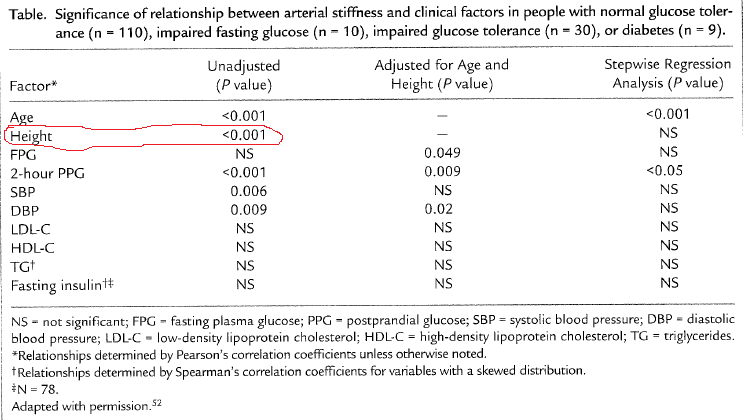
Take a look at the table below, which I blogged about in a previous post (). This table shows that there is a strong unadjusted correlation between height and arterial stiffness, a marker of heart disease. The likelihood that the correlation is due to chance is lower than one tenth of a percentage point (P<.001).


Interestingly, the authors of the study even use height as a control variable to narrow down the “true” causes of arterial stiffness (column with adjusted results), assuming that height did indeed influence arterial stiffness and what they found to be a key predictor of arterial stiffness, 2-hour postprandial glucose.

But there is no convincing evidence that height causes heart disease, with exception of pathological extremes – e.g., acromegaly. Extremes tend to influence statistical results somewhat, leading to conflicting conclusions that end up being disseminated by the popular media (). This is one of the sources of popular beliefs about medical issues.

Another, more important, source are real confounders. And this takes us back to the issue of height being associated with heart disease. In fact, height will typically be significantly associated with heart disease in almost any study that includes men and women and does not control for biological sex.

One of the reasons is that women overall tend to have a significantly lower incident of heart disease than men. The other is that height is significantly lower among women than men, on average, even though there are several women who are taller than the average man.

The table above was from a study including both sexes. Therefore, the strong association between height and arterial stiffness is a “reflection” of the strong association between being male and increased arterial stiffness. If one were to add a variable coded as 0 for male and 1 for female, and use it in a multivariate analysis of predictor of arterial stiffness, together with height, the effect of height would probably “disappear”.

Biological sex is the control variable, the “confounder”, that the authors should have used to narrow down the “true” causes of arterial stiffness (second column in the table). In the absence of biological sex, controlling for height accomplished something similar, but in a “wobbly” way, leaving many readers scratching their heads in confusion.